
Insurance Through Banks: Complete Guide to Bancassurance Plans
State Life Insurance Through Banks, often called bancassurance, allows customers to access insurance products through their bank. It can make buying coverage more convenient because you can explore insurance options while managing your everyday banking needs. From life and health coverage to savings and protection plans, banks may offer different solutions based on your financial goals. In this complete guide to Bancassurance Plans, we’ll explain how insurance through banks works, its benefits and limitations, what to check before choosing a plan, and how to make a smart decision for your financial future.
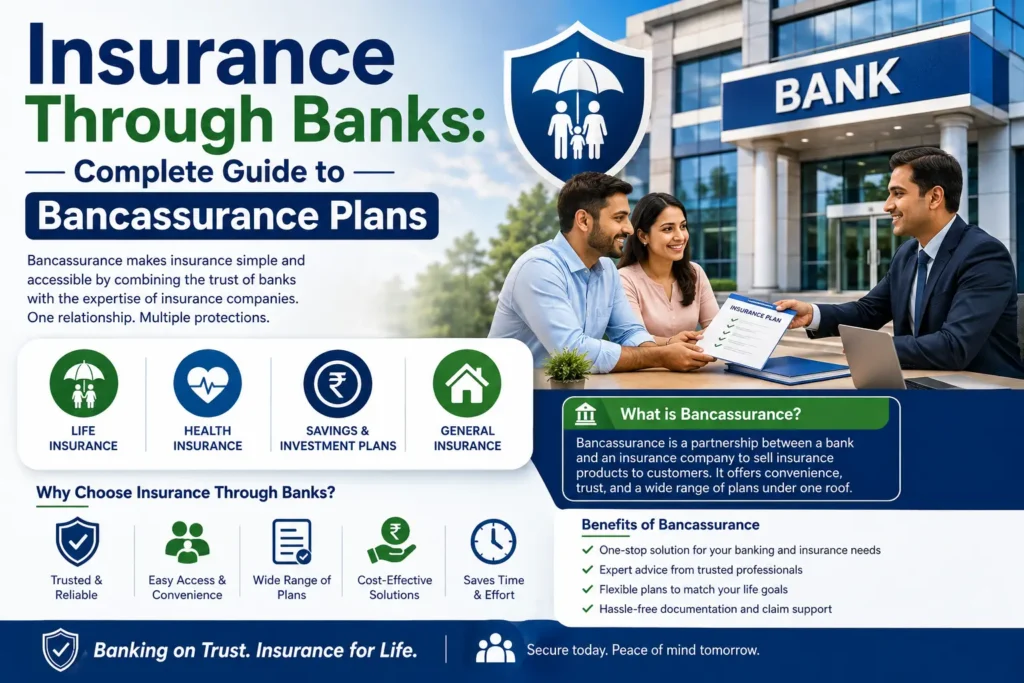
Insurance Through Banks: Complete Guide to Bancassurance Plan
Somewhere between opening a fixed deposit and asking about a locker, someone at your bank has probably asked if you’re covered. That conversation has a name — bancassurance — and it has become an important way people buy insurance. Here’s what actually happens when insurance is sold through a bank, what to check before buying, and how to tell a useful offer from a rushed cross-sell.
What’s in this guide
- What insurance through banks actually means
- How the process works, step by step
- The plans banks actually sell
- Who benefits, and how
- What it costs — an indicative price table
- Why banks got into insurance
- Bank channel vs. buying from an agent
- How to choose well, not fast
- What to watch out for
- Major bancassurance players
- Questions people usually ask
What Insurance Through Banks Actually Means
Insurance through banks — often called bancassurance — is simply insurance sold to you through your bank instead of directly by an insurance company’s salesperson or an independent advisor.
The important thing to understand is that the bank usually does not manufacture the insurance policy. Instead, it has a partnership with one or more insurance companies and distributes their products to eligible customers.
This arrangement can make buying insurance more convenient because you already have a relationship with the bank. Depending on the arrangement, the bank representative may be able to help with applications, documentation, premium payments and basic policy servicing.
How the Process Works, Step by Step
Buying insurance through banks generally follows a straightforward process. The exact steps can vary depending on the bank, insurer and type of policy.
1. Needs check
The representative may ask about your income, dependents, existing insurance and financial goals.
2. Plan match
Products from the bank’s partner insurers are presented based on your requirements and eligibility.
3. Documentation & issue
After completing the required documentation, the insurer evaluates the application and issues the policy if approved.
Remember the key distinction: the bank and the insurer are not necessarily the same business. The insurance company is responsible for underwriting the policy and handling claims according to the policy terms.
The Plans Banks Actually Sell
The exact products available depend on the bank and its insurance partnerships, but bancassurance commonly includes several familiar types of insurance.
| Plan type | What it covers | Common reason for buying |
|---|---|---|
| Term life insurance | Provides a death benefit to eligible beneficiaries during the policy term. | Family protection |
| Loan-linked cover | Can help protect against outstanding loan liabilities after the insured borrower’s death, subject to policy terms. | Home or personal loans |
| Endowment / savings plans | Combines life insurance with a savings-oriented structure. | Long-term financial planning |
| Health insurance | Helps cover eligible medical and hospitalisation expenses according to the policy. | Individual or family protection |
| ULIPs | Combines life insurance with market-linked investment components. | Long-term financial goals |
| General insurance | May include motor, home, travel and other forms of non-life insurance. | Vehicle, home or travel needs |
Term insurance is often considered when the primary goal is affordable financial protection for dependents. Savings-linked products work differently, so always understand what you are buying before comparing premiums.
Who Benefits, and How
Bancassurance can benefit several parties when it is used properly. The customer gets convenience, the bank gets an additional source of revenue, and the insurer gets access to a large customer base.
For you, the customer
Buying through a bank can reduce friction because you may already have your account information and KYC documents with the bank. Digital applications can also make the process faster.
For the bank
Insurance distribution can create additional revenue while allowing the bank to offer a wider range of financial products to its customers.
For the insurer
Partnering with banks can give insurers access to an established distribution network and a large group of existing customers.
What It Costs — An Indicative Price Table
The cost of insurance depends on several factors, including age, health, policy type, coverage amount, policy term, occupation and other underwriting details.
| Cover type | Example profile | Indicative premium |
|---|---|---|
| Term plan | 30-year-old, non-smoker | Varies by insurer |
| Term plan | 40-year-old, non-smoker | Higher than younger profile |
| Loan-linked cover | Home loan borrower | Depends on loan & policy |
| Family health plan | Family of four | Depends on age & coverage |
| Endowment plan | Long-term savings goal | Depends on policy structure |
These examples are for general understanding rather than formal quotes. Actual premiums can vary significantly. Always request the insurer’s official illustration and policy documents before buying.
Why Banks Got Into Insurance in the First Place
Banks have strong customer relationships, extensive branch networks and digital platforms. Insurance companies can use these channels to reach customers more efficiently.
For banks, insurance distribution can also diversify their revenue beyond traditional lending and deposit services. For insurers, bancassurance can provide a powerful distribution channel.
Bank Channel vs. Buying From an Agent
| Factor | Insurance through banks | Independent advisor |
|---|---|---|
| Convenience | High if you already bank there | Depends on advisor |
| Product choice | Usually limited to partner insurers | May compare more insurers |
| Documentation | May be easier for existing customers | Depends on provider |
| Advice | Convenient but tied to bank products | May offer broader comparison |
| Comparison shopping | Can be limited | Often wider |
Neither option is automatically better. The best choice depends on whether convenience or wider product comparison matters more to you.
How to Choose Well, Not Fast
A bank representative may explain an insurance plan quickly. Before accepting the offer, take a few minutes to check the most important details.
- Ask why the policy is being recommended and what specific financial need it is designed to address.
- Confirm whether the product is term insurance, health insurance, savings-linked insurance or an investment-linked product.
- Get the exact premium, coverage amount, policy term and major exclusions in writing.
- Check the free-look period, cancellation rules and surrender conditions before signing.
- Compare the recommended policy with at least one or two alternatives before making a long-term commitment.
What to Watch Out For
Bancassurance can be convenient, but convenience should not replace careful decision-making.
Mis-selling under time pressure. If a policy is explained very quickly, ask for the product brochure and policy documents so you can review them before making a decision.
Unwanted bundling. If insurance is presented together with another financial product, ask whether the insurance is optional or required and request a clear explanation of why it is being recommended.
Confusing savings with protection. Insurance products can have very different purposes. A product designed mainly for savings is not the same as straightforward term protection.
Ignoring exclusions. The headline benefit is only one part of a policy. Always check exclusions, waiting periods, conditions and claim requirements.
Major Bancassurance Players
India has several well-known bank and insurer relationships. Examples include State Bank of India and SBI Life, HDFC Bank and HDFC Life, ICICI Bank and ICICI Prudential Life, and Axis Bank and Max Life.
These relationships can change over time, and product availability varies by bank, insurer and customer eligibility. Before buying, check the current product information directly with the bank and insurance company.
Questions People Usually Ask
Hover over a question on desktop, or tap it on mobile, to see the answer.
Final Thoughts
Insurance through banks is essentially a convenient distribution channel that connects customers with insurance companies. It can save time and make the buying process easier, especially when you already have a banking relationship.
But convenience should never be the only reason to buy a policy. Take time to check the coverage amount, premium, policy duration, exclusions, claim conditions and cancellation rules.
If a bank representative recommends a policy, ask simple questions, compare alternatives and make sure the product matches your actual financial needs. The goal is not simply to buy insurance quickly; it is to choose protection that can remain useful for years.