
Digital Insurance: Complete Guide to Online Insurance Plans
State Life Digital insurance has made it easier than ever to explore, compare, and manage insurance plans online. Instead of visiting an office or handling piles of paperwork, you can now get quotes, choose coverage, make payments, and manage your policy from your phone or computer. In this Digital Insurance: Complete Guide to Online Insurance Plans, we’ll explain how digital insurance works, its key benefits, common types of online insurance, and important tips to help you choose the right plan for your needs.
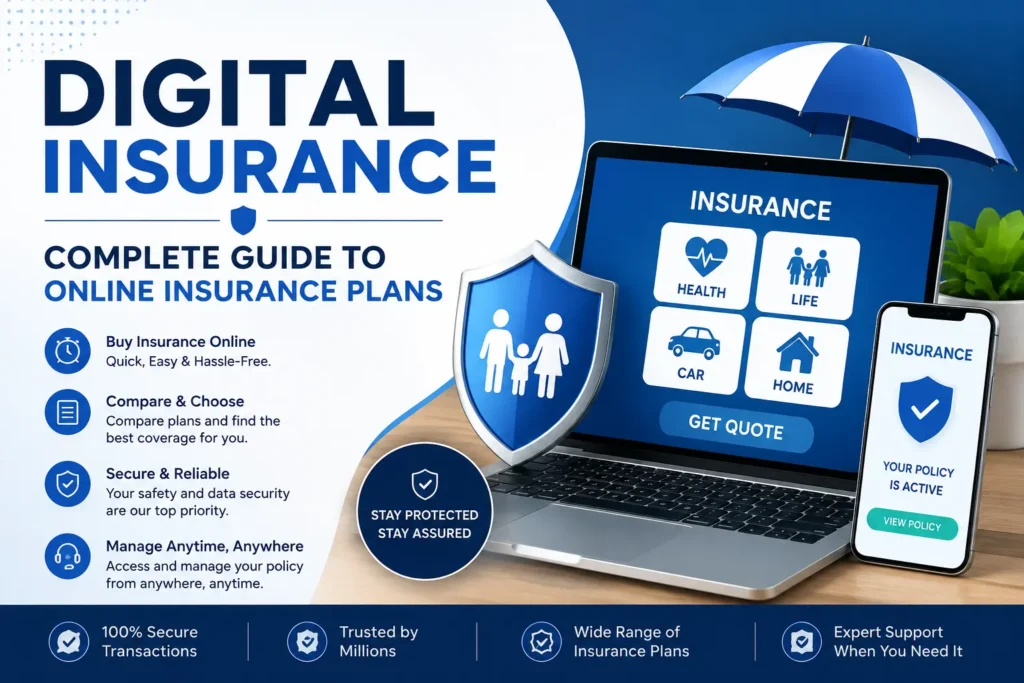
Digital Insurance: Complete Guide to Online Insurance Plans
Everything you need to know before buying, comparing, or claiming a digital insurance policy in 2026 — pricing, plan types, and the questions people search for most.
Buying a policy used to mean sitting across a desk from an agent, signing a stack of paper forms, and waiting days for anything to actually get confirmed. That world is fading fast. Digital insurance has turned a process that once took a week into something you can finish on your phone before your coffee gets cold.
If you have ever booked a flight, ordered dinner, or moved money between accounts online, you already understand the logic here. It brings that same speed, transparency, and control to something as important as protecting your health, your car, your home, or your income. No paperwork drawer, no waiting room, no guessing what is actually covered until a claim goes wrong.
This guide walks through what digital insurance really is, how it works behind the screen, what it costs today, how it compares with traditional and bank-sold policies, and how to choose a plan that fits your life instead of a salesperson’s monthly target. Whether you are insuring your first car or rethinking your family’s health cover, understanding it properly now will save you money and stress later. Stick with it to the end — the pricing tables and the FAQ section near the bottom answer the questions people search for most.
01What is digital insurance
Put simply, digital insurance is the buying, managing, and claiming of an insurance policy through online channels rather than a physical branch or an in-person agent. It covers everything from comparing quotes on a website to uploading documents for a claim through a mobile app. The policy itself — whether it is health, motor, travel, life, or home cover — is not fundamentally different from a traditional one. What changes is the delivery method.
A useful way to think about it is as the same product sold through a faster, cheaper, and more transparent pipe. Insurers who operate digitally cut out branch rent, printed brochures, and layers of middlemen. Those savings often get passed on as lower premiums, and the entire buying journey becomes something you control from a screen rather than something that happens to you across a desk.
Digital insurance is not one single thing either. It ranges from a legacy insurer simply adding an online portal, to fully digital-first insurtech companies that never had a physical branch to begin with. Both fall under the same umbrella, but the customer experience between them can be very different.
02How digital insurance actually works
The mechanics behind this system are built around a handful of connected pieces working together in the background.
First, comparison and quote engines pull your details — age, location, asset value, and risk factors — then run them against pricing algorithms from one or several insurers at once. This is why a quote can appear in seconds instead of the days a manual underwriter used to need.
Second, identity and document verification happens through your phone camera and government ID databases, replacing the notarized paperwork that used to slow everything down. Third, payments are processed instantly through cards, wallets, or bank transfers, and your policy document is generated and emailed the moment the payment clears.
Finally, claims in a typical setup are filed through an app or web portal. You photograph the damage or upload a medical bill, answer a short set of questions, and an algorithm or a remote adjuster reviews it. Simple, well-documented claims can be approved within hours rather than weeks, which is one of the biggest reasons people are switching over. Every one of these steps exists to strip out the waiting that used to define buying cover.
1. Quote
Enter details once, get pricing from multiple insurers instantly.
2. Verify
ID and documents confirmed digitally — no branch visit needed.
3. Pay & activate
Policy document lands in your inbox the moment payment clears.
4. Claim
Upload evidence through the app and track status on a dashboard.
03Types of digital insurance plans
Not every plan in this space behaves the same way, so it helps to see the main categories side by side before deciding which one applies to your situation.
| Plan type | What it typically covers | Common digital feature |
|---|---|---|
| Health | Hospitalization, outpatient care, medicines | Bundled telehealth consultations |
| Motor | Own-damage, third-party liability, theft | Pay-as-you-drive, app-based pricing |
| Life (term) | Death benefit for dependents | Questionnaire-based underwriting, no exam |
| Travel | Trip cancellation, medical, baggage loss | Instant issue at flight booking |
| Home | Fire, theft, structural damage | Photo-based claims assessment |
Health cover bought digitally usually includes telehealth consultations bundled in, since insurers know policyholders who catch problems early file smaller claims later. Motor plans lean heavily on usage data now, with some insurers offering pay-as-you-drive pricing tracked through an app. Life insurance sold online tends to be term-based because it is the easiest product to underwrite with a short questionnaire instead of a medical exam.
04Digital insurance vs traditional insurance
The biggest difference between the two routes is not the coverage itself but the friction removed from every step in between.
| Factor | Digital insurance | Traditional insurance |
|---|---|---|
| Quote time | Seconds to minutes | Hours to days |
| Comparison | Multiple insurers, one screen | One agent at a time |
| Paperwork | Digital upload | Physical signatures |
| Typical premium | Often 10–30% lower | Higher due to overhead |
| Claim tracking | Live app dashboard | Phone calls, branch visits |
| Human advice | Limited, chat-based | In-person broker judgment |
Traditional insurance still has a place, particularly for complicated commercial policies or high net worth cover where a human broker adds real judgment. But for everyday health, motor, travel, and term life needs, it now matches or beats traditional coverage on price while cutting the waiting time down from days to minutes.
05How big is the digital insurance market right now
The scale of this shift is not small. Industry research places the global online insurance market at roughly $121 billion in 2025, climbing toward almost $149 billion in 2026 — a jump driven largely by smartphone adoption, mobile payment growth, and comparison platforms making shopping around effortless. Forecasts point toward the market more than doubling again by 2030. Whatever the exact figure any single report lands on, the direction is the same everywhere you look: online-first buying keeps eating share from branch-based selling every year.
Global online insurance market size, 2025–2030 (USD billions, illustrative)
Source: industry market research on the global online insurance sector. Figures are rounded estimates, not a guarantee of future performance.
06What digital insurance actually costs
Pricing is where this model tends to win outright, since the savings from cutting branches and agents usually flow back to the customer as a lower premium. Below is a rough, illustrative comparison across common categories so you can see the general pattern — your own quote will always depend on your age, location, and risk profile.
| Plan type | Typical online premium range* | Typical branch-sold range* |
|---|---|---|
| Basic health cover | $15 – $60 / month | $25 – $80 / month |
| Motor (third-party) | $8 – $25 / month | $12 – $35 / month |
| Motor (comprehensive) | $25 – $90 / month | $35 – $115 / month |
| Term life ($100k cover) | $10 – $30 / month | $15 – $40 / month |
| Single-trip travel | $5 – $20 / trip | $8 – $28 / trip |
*Illustrative ranges only — actual pricing varies by country, age, and risk profile.
These numbers are indicative starting points rather than guarantees, since actual pricing shifts with your city, driving record, medical history, and the specific insurer’s risk appetite. Still, the pattern holds fairly consistently: online premiums usually land ten to thirty percent below an equivalent branch-sold policy because of lower overhead.
Want more money guides like this one? StayLifee covers insurance, saving, and everyday finance in plain language.
Explore StayLifee07Key benefits of choosing digital insurance
People do not switch to it because it is trendy. They switch because it solves real annoyances with the old system.
- Speed — with digital insurance, a quote and purchase can be wrapped up in under ten minutes on a phone, compared with an office visit that eats an entire afternoon.
- Transparency — every plan detail, exclusion, and premium breakdown sits in front of you in writing rather than being explained verbally and half-remembered later.
- Real comparison shopping — you can pull up four or five online quotes on separate tabs and compare them line by line, something almost nobody bothered doing when it meant four separate branch visits.
- Claims tracking — you can watch your claim move through each stage on a dashboard instead of calling a helpline and hoping someone picks up.
- Lower cost — lower operating expenses for insurers translate into premiums that are frequently more competitive, plus flexible add-ons you can switch on or off without rewriting an entire policy.
There is also a quieter benefit that rarely gets mentioned: honesty by design. When a plan document sits on a screen instead of being read aloud by someone paid to close the sale, there is less room for a policy to be oversold. You can screenshot the exclusions, share them with a family member, sleep on the decision overnight, and come back the next day without any pressure to sign before you leave the office. For anyone who has ever felt rushed into a policy they did not fully understand, that alone is worth the switch.
08Digital insurance vs bancassurance
Banks have long sold insurance alongside savings accounts and loans, a model known as bancassurance, and it is worth understanding how that compares with buying cover directly from an insurer or an online marketplace. We covered this model in detail in our dedicated piece below, which is worth reading if you are weighing a bank-bundled policy against an independent online purchase.
Insurance Through BanksThe short version is that bancassurance often bundles a policy with a loan or account opening, which can feel convenient but sometimes limits your choice of insurer and coverage terms. Cover purchased independently online usually gives you a wider comparison pool and clearer pricing, since you are not tied to whichever single insurer your bank has partnered with. If you want the full breakdown of how bank-sold policies work, our guide on Insurance Through Banks covers the fees, commissions, and fine print banks rarely explain upfront.
09How to choose the right digital insurance plan
Picking a good plan in this space is less about finding the cheapest number on the page and more about matching coverage to your actual risk.
Start by listing what you genuinely need covered rather than what a homepage banner for a digital insurance provider is pushing. Then compare at least three online quotes side by side, paying close attention to exclusions and waiting periods rather than just the headline premium. Check the insurer’s claim settlement ratio if it is published, since a cheap policy that never pays out is not actually cheap.
Read the fine print on renewal terms too, because some plans quietly increase premiums after the first year once you are less likely to shop around. Finally, confirm how claims are actually filed and how long payouts typically take, ideally by checking recent customer reviews rather than taking the marketing page at its word. A well-chosen plan should feel boring in the best way: predictable, well-documented, and easy to act on when something actually goes wrong.
10Risks and things to watch before you buy
This model is not without its downside. Fully automated underwriting can sometimes misprice unusual risk profiles that a human agent might have caught. Customer support for complex claims can feel impersonal if everything is routed through a chatbot first. And because switching insurers online is so easy, some buyers chase the lowest premium every renewal without checking whether coverage quietly shrank along the way.
The fix is simple enough: read the policy wording before you buy, not after you file a claim, and keep a copy of every document you receive somewhere you can find it later. It is also worth checking whether the platform selling the policy is itself licensed and regulated, rather than an unlicensed comparison site simply forwarding your details to the highest bidder. A quick search of the regulator’s public register takes two minutes and can save you from a policy that was never properly backed in the first place.
11Where digital insurance is headed next
Expect this space to keep leaning further into personalization over the next few years. Wearables and connected car data are already feeding into pricing models, rewarding safer, healthier behavior with lower premiums in near real time. Artificial intelligence is speeding up claims review further, and embedded insurance — where cover is offered automatically at the point of buying a phone, a flight, or a car — is quietly becoming one of its fastest-growing corners.
None of this means the human side disappears completely. Complex commercial risk and high value assets will likely always need a knowledgeable broker in the loop. But for the everyday policies most people actually buy, buying online is no longer the alternative option. It has become the default one.
More guides on insurance, savings, and smart money moves are waiting for you on StayLifee.
Visit StayLifee12Frequently asked questions
Tap any question to expand the answer — hover on desktop for a quick preview.
Is digital insurance actually safe to buy?+
Yes, provided the insurer or platform is licensed by your country’s insurance regulator. Look for the license or registration number in the footer of the website, check that payments go through a secure gateway, and confirm the policy document arrives with the insurer’s official letterhead rather than just a generic email template.
Is digital insurance cheaper than buying through an agent?+
Usually, yes. Since online insurers spend less on branches, printed material, and agent commissions, that saving is frequently reflected in the premium. It is not guaranteed for every single product, so it still pays to compare a handful of quotes before assuming the online option wins automatically.
Can I switch from a traditional policy to a digital one?+
In most cases, yes. You can typically let your current policy run to renewal, compare digital quotes in the meantime, and switch once you find better terms. Some insurers also allow mid-term cancellation with a prorated refund, though it is worth checking the cancellation clause first.
What documents do I need to buy a digital insurance plan?+
Generally just a government ID, proof of address, and details of the asset or person being insured, such as a vehicle registration number or basic medical history. Everything is usually uploaded as a photo or scan directly through the website or app.
How fast are claims settled with digital insurance?+
Simple, well-documented claims are often settled within a few hours to a few days, especially for smaller amounts that qualify for automated processing. Larger or more complex claims still involve a human adjuster and can take longer, though the tracking dashboard keeps you updated at every stage.
Does digital insurance cover pre-existing conditions or older vehicles?+
It depends entirely on the insurer and the specific plan, exactly as it would with a traditional policy. Some digital health plans exclude pre-existing conditions for an initial waiting period, and some motor insurers cap coverage for vehicles past a certain age. Always check the eligibility section before assuming coverage applies.
Is bancassurance the same thing as digital insurance?+
Not quite. Bancassurance refers to insurance sold through a bank, often bundled with a loan or account, and it can be arranged in person or online. Digital insurance simply describes the online buying and servicing process itself. See our full guide, Insurance Through Banks: Complete Guide to Bancassurance Plans, for the breakdown.
Can I get a refund if I cancel my policy early?+
Most insurers offer a short free-look period, commonly between ten and thirty days, during which you can cancel for a full refund if you have not filed a claim. After that window, refunds are usually prorated based on the time remaining on your policy, minus any applicable fees.
Do I need a medical exam for a digital life insurance plan?+
Many online term life plans skip the in-person medical exam for younger applicants with lower coverage amounts, relying instead on a detailed health questionnaire. Higher coverage amounts or older applicants may still be asked to complete a basic medical screening, sometimes arranged through a home visit from a lab technician.
What happens if the insurer’s app or website goes down during a claim?+
Reputable insurers maintain a phone or email backup channel specifically for situations like this, and regulators typically require insurers to accept claims through more than one channel. If an app outage is preventing you from filing, document the issue with a screenshot and the time, since most insurers will honor claims filed shortly after service is restored.
So back to where this guide started: the desk, the paperwork, and the days-long wait are optional now, not mandatory. Digital insurance gives you the same protection with far less friction, and once you have compared a few quotes yourself, it is genuinely hard to go back to the old way of doing it.
For more no-nonsense guides on insurance and personal finance, browse the full library on StayLifee.
Read more on StayLifee