
Anticipated Endowment Assurance: Guide, Benefits & Cost 2026
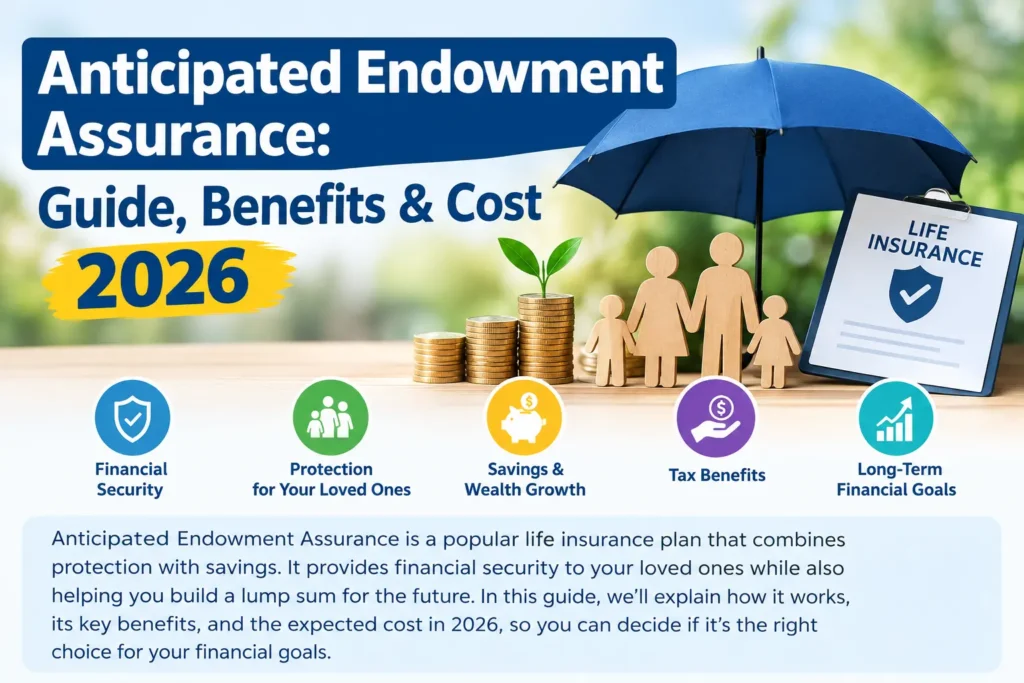
State Life Anticipated Endowment Assurance is a life insurance plan that combines financial protection with long-term savings. It can help protect your family while also providing planned payouts during the policy term, depending on the policy conditions. In this guide, we’ll explain how Anticipated Endowment Assurance works, its key benefits, important features, and the expected cost and premium considerations in 2026, so you can better understand whether this type of policy fits your financial goals.
Anticipated Endowment Assurance: Guide, Benefits & Cost 2026
The plan that pays you in instalments, not just at the end. Here’s exactly how it works, what it costs in 2026, and whether it belongs in your financial plan.
Most people assume life insurance money only shows up in two situations: someone dies, or a policy finally matures years down the road. Anticipated endowment assurance breaks that assumption. It hands you a slice of the sum assured every few years while you’re still alive, still healthy, and still very much in need of cash for the ordinary milestones life throws at you — school admissions, a wedding, a home deposit — while keeping the full death benefit intact the entire time.
This guide walks through how anticipated endowment assurance actually pays out, what it costs at different ages in 2026, how it stacks up against a standard Endowment Assurance plan, and the questions people ask right before signing on the dotted line.
What Is Anticipated Endowment Assurance?
Think of it as a hybrid between a savings plan and a protection policy, built specifically for people who don’t want to wait fifteen or twenty years to see any return on their premium. Instead of a single lump sum at the finish line, the insurer schedules partial payouts — often called survival benefits — at fixed points during the term, say every five years.
The clever part is what happens to the death cover. Unlike a plan where withdrawals shrink your protection, anticipated endowment assurance keeps the full sum assured available to your family if you pass away, no matter how many survival instalments you’ve already collected. You get liquidity along the way without trading away the safety net at the end.

How Does the Payout Schedule Actually Work?
Every insurer structures the instalments slightly differently, but the pattern usually looks like this: a percentage of the sum assured — commonly 15 to 25 percent — gets paid out at regular intervals, with a larger final chunk plus accumulated bonuses released at maturity. The table below shows a typical 20-year schedule on a $50,000 sum assured.
| Policy Year | Survival Benefit Paid | Running Total Received |
|---|---|---|
| Year 5 | 20% ($10,000) | $10,000 |
| Year 10 | 20% ($10,000) | $20,000 |
| Year 15 | 20% ($10,000) | $30,000 |
| Year 20 (Maturity) | 40% + bonuses ($20,000+) | $50,000+ |
Notice how the final maturity payout is deliberately larger than each earlier instalment. That’s intentional — it’s where the bulk of the accumulated bonus sits, rewarding policyholders who stay the full course rather than treating each instalment as a reason to walk away.
What Happens If Death Occurs Mid-Term
- Full sum assured is paid — beneficiaries receive the entire original amount, not just what’s left after prior instalments.
- Accrued bonuses are added — most policies include bonuses earned up to the date of death.
- Prior survival payouts are not deducted — this is the single biggest reason people choose this structure over a simple savings account.
Key Benefits of Anticipated Endowment Assurance
The structure earns its popularity through a handful of practical advantages that show up in real household budgeting.
| Benefit | What It Means for You |
|---|---|
| Scheduled liquidity | Cash arrives at predictable intervals, matching real expenses like tuition or a milestone purchase. |
| Full death benefit throughout | Earlier payouts don’t reduce what your family receives if you pass away during the term. |
| Built-in savings discipline | Premiums are locked in, so the habit of saving continues even between payout dates. |
| Bonus accumulation | Reversionary and terminal bonuses typically boost the final maturity amount beyond the base guarantee. |
| Tax efficiency | In most jurisdictions, survival benefits and maturity proceeds from a qualifying policy are exempt from income tax. |
None of this makes the plan universally ideal — it works best for people with genuinely staged financial needs rather than a single distant goal, which is where a standard lump-sum structure might serve better instead.
Cost & Premium Breakdown for 2026
Because part of every premium funds scheduled payouts rather than sitting invested for the full term, anticipated endowment assurance tends to cost more per month than a comparable lump-sum plan with the same sum assured. The table below is an illustrative snapshot for a healthy, non-smoking applicant in 2026.
| Age at Entry | Term | Sum Assured | Approx. Monthly Premium |
|---|---|---|---|
| 25 years | 20 years | $50,000 | $185 – $220 |
| 30 years | 20 years | $50,000 | $205 – $245 |
| 35 years | 15 years | $50,000 | $260 – $305 |
| 40 years | 15 years | $75,000 | $390 – $455 |
| 45 years | 10 years | $75,000 | $510 – $590 |
Entry age and term still drive the biggest swings in premium, but the payout frequency matters too — a plan releasing money every three years will typically cost more monthly than one paying out every five, since the insurer has less time to grow each portion of the fund before it’s released.
Curious what a scheduled payout plan would cost for your exact age and goals? Compare real quotes at staylifee.com before you commit to anything.
Anticipated Endowment Assurance vs Standard Endowment Assurance
These two sit close together on paper, but the cash-flow experience is completely different. A standard Endowment Assurance plan holds every dollar until the very end, delivering one lump sum on maturity or on earlier death. This version breaks that single payout into smaller, scheduled pieces during the term, then finishes with a final balance.
| Feature | Anticipated Endowment Assurance | Standard Endowment Assurance |
|---|---|---|
| Payout timing | Periodic instalments plus final balance | Single lump sum at maturity or death |
| Cash flow during term | Yes, at fixed intervals | None until maturity |
| Premium level | Slightly higher for same sum assured | Lower for same sum assured |
| Best for | Staged goals like fees or milestones | One large future goal |
If your money needs are spread across several life stages rather than one distant target, the anticipated structure fits more naturally. If you’re saving for a single event years from now and don’t need cash before then, a standard plan usually delivers a larger final number for the same premium, simply because none of the fund gets released early.
How the Payout Builds Over the Term
The chart below illustrates a typical growth and payout pattern for a 20-year plan with a $50,000 sum assured, showing both the instalments received and the remaining fund value building toward maturity.
Illustrative payout pattern for a $50,000 plan with instalments at years 5, 10 and 15, plus final maturity balance. Actual figures vary by insurer.

Who Should Actually Buy This Plan?
Anticipated endowment assurance tends to fit a specific kind of household, not everyone. It works well if:
- You have predictable, staged expenses — school fees every few years, a wedding fund, periodic home upgrades.
- You want life cover but also value getting some return before the policy fully matures.
- You’re disciplined enough to reinvest or save each instalment rather than spending it immediately.
- You’d rather have guaranteed scheduled cash than manage a separate investment portfolio for the same goals.
It’s a weaker fit if you have one single distant financial goal and no need for interim cash, since a standard lump-sum plan usually produces a larger final payout for the same premium.
Pros and Cons at a Glance
| Pros | Cons |
|---|---|
| Regular cash inflow during the term | Higher premiums than a lump-sum plan |
| Death benefit unaffected by earlier payouts | Smaller final maturity figure vs a lump-sum plan |
| Matches staged life expenses well | Instalments may tempt overspending if not planned |
| Often tax-advantaged | Less suited to single long-term goals |

How to Choose the Right Plan
1. Match instalment timing to real expenses
Map out when you’ll actually need cash — school fee cycles, a wedding date, a planned home upgrade — and pick a payout schedule that lands close to those dates.
2. Check whether missed instalments are optional
Some insurers let you defer a survival benefit and let it accumulate interest instead of taking the cash immediately. Ask about this flexibility before signing.
3. Confirm the death benefit terms in writing
Make sure the policy document explicitly states that prior survival payouts are not deducted from the death benefit — this detail varies more than most buyers expect.
4. Compare the bonus track record
Ask for at least ten years of historical bonus rates rather than relying on a single projected illustration, since projections aren’t guaranteed.
Ready to see a personalised payout schedule based on your age and goals? Get a real quote at staylifee.com — no pressure, just numbers.
Real-World Scenario: Planning Around Staged Goals
Take a 33-year-old parent with two children, six years apart. Rather than one large payout that arrives too late for the first child’s university fees, an anticipated endowment assurance plan with instalments at years 12 and 18 lines up almost perfectly with each child’s milestone, while the family still keeps full death protection the entire time. That kind of staged alignment is difficult to replicate with a standard lump-sum policy or a plain savings account.
Anticipated Endowment Assurance and Inflation Planning
A payout schedule that looks generous on paper today can feel thinner by the time each instalment actually arrives, once ordinary living costs have crept upward over five or ten years. This is one detail buyers of anticipated endowment assurance often overlook when comparing illustrations side by side. The practical fix is simple: size the sum assured a notch higher than your current target figure, and revisit that number every few years rather than locking in a value based purely on today’s prices. Because anticipated endowment assurance releases money in stages rather than all at once, this kind of periodic review actually fits naturally into how the plan already works — each instalment date is a built-in checkpoint to reassess whether the remaining schedule still matches your goals.
How Anticipated Endowment Assurance Fits Into a Wider Plan
Very few advisors recommend anticipated endowment assurance as someone’s only financial product, and that’s by design. It plays a specific role — scheduled, guaranteed liquidity alongside life cover — rather than trying to be a complete retirement or investment strategy on its own. Many households pair an anticipated endowment assurance policy with a separate long-term investment account for goals that don’t have a fixed date, while relying on the scheduled instalments strictly for milestones they can already see coming. Used this way, anticipated endowment assurance becomes one deliberate piece of a larger plan rather than the entire plan itself.
Common Mistakes People Make
- Spending every instalment immediately — the plan works best when at least part of each payout gets reinvested or saved.
- Choosing intervals that don’t match real needs — a five-year cycle is pointless if your actual expenses land every three years.
- Assuming the death benefit shrinks after payouts — in most policies it doesn’t, but it’s worth confirming in writing rather than assuming.
- Comparing premiums without comparing structure — a cheaper plan that pays only at maturity isn’t automatically worse, it’s simply solving a different problem than one built around scheduled payouts.
Frequently Asked Questions
What is anticipated endowment assurance?
How does the payout schedule usually work?
Does the death benefit reduce after a survival payout?
Is this the same as a standard Endowment Assurance plan?
Who benefits most from staged payouts?
Are the survival benefits taxable?
What happens if I need cash between instalment dates?
Does a missed instalment affect the policy?
Is the final maturity amount smaller than a lump-sum plan?
Final Thoughts
Anticipated endowment assurance isn’t about chasing the highest possible number at the end of the term. It’s built around a different question entirely: when do you actually need the money? For households with real, staged expenses stretched across years rather than a single distant goal, that scheduled cash flow, paired with an untouched death benefit, is genuinely hard to replicate through any other single product.
Before signing anything, map your real expense dates against the insurer’s payout schedule, confirm the death benefit terms in writing, and compare at least two structures side by side. A quick way to see live numbers rather than rough estimates is a comparison at staylifee.com, where you can weigh a scheduled payout plan against a standard lump-sum option before committing either way.



One Comment