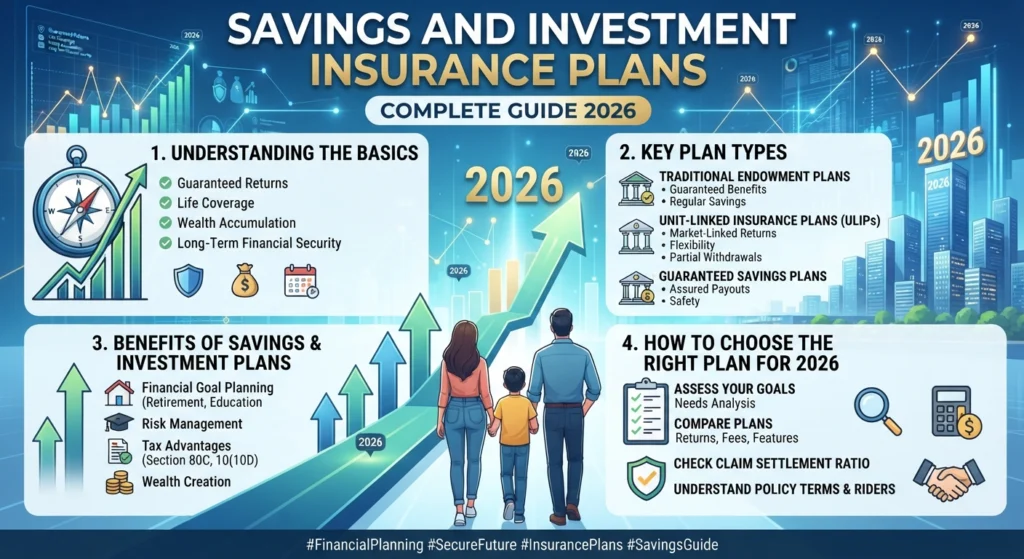
Savings and Investment Insurance Plans: Complete Guide 2026
State Life Planning for the future requires more than simply saving money. Savings and Investment Insurance Plans can combine financial protection with long-term savings and investment goals, helping individuals prepare for important needs such as children’s education, retirement, family security, or future expenses. These plans may provide life insurance coverage while also building a financial value over the policy term, depending on the type of plan and its terms.
In this complete guide to Savings and Investment Insurance Plans 2026, we will explain how these plans work, their key benefits, costs, investment features, eligibility requirements, and important factors to consider before choosing a policy. Whether you are starting your financial planning journey or looking for a structured way to build long-term savings, Family Protection Life Insurance this guide will help you understand the basics and make an informed decision.
Savings and Investment Insurance Plans: Complete Guide 2026
Most people do not lose money because they earn too little. They lose it because it sits in the wrong place. A salary account that pays almost nothing, a committee that falls apart, a plot bought on a cousin’s tip. Then a hospital bill or a lost job arrives, and the whole plan wobbles.
A Savings and Investment insurance plan tries to fix that with one product. You pay a fixed amount on a schedule, part of it builds a cash value, and the rest buys life cover, so your family stays protected while the fund grows. This guide covers how these plans work in 2026, what they cost, where they fall short, and how to choose one without regret. Read to the very end, because the mistake most buyers make happens before they compare a single premium.
The short answer
- A Savings and Investment plan mixes life cover with a growing fund.
- It suits people with dependants, a 10-year-plus horizon, and a habit of skipping manual saving.
- It does not suit money you need within three years.
- Typical monthly contribution in 2026: PKR 5,000 to 30,000, depending on the plan.
What Savings and Investment Insurance Plans Really Are
Think of it as a savings account with a seatbelt. You agree to pay a premium every month, quarter, or year for a fixed period, usually 10 to 25 years. The insurer splits every payment. One slice pays for life cover, another covers charges, and the rest goes into a fund that builds up over time.
That fund is where the Savings and Investment side lives. In a traditional plan the insurer manages it conservatively and adds bonuses. In a unit-linked plan you pick the funds, and the value moves with the market. Either way, if you die during the term your family receives the sum assured, and if you reach the end you collect the maturity value.
This is different from a plain term plan, which only pays on death, and different from a mutual fund, which has no life cover at all. The mix is the whole point. It suits anyone who wants discipline, protection, and growth from one monthly payment.
Why Savings and Investment Plans Matter in 2026
Prices keep climbing. Groceries, school fees, and medical care cost noticeably more than they did three years ago, and idle cash loses buying power every month. At the same time, many households lean on a single earner. If that income stops, ordinary savings rarely stretch far enough.
That is the case for pairing Savings and Investment with protection. An automatic, locked plan removes the daily temptation to spend, and the life cover means the goal survives even if you do not. Parents use these plans for university fees, business owners use them as a retirement layer, and salaried workers use them because the habit is forced on them.
There is a second reason this year: choice. Insurers now publish clearer benefit illustrations, accept online payments, and offer Shariah-compliant takaful versions of many plans. If you live in Pakistan, established names such as State Life sell these products, and comparing two or three quotes takes an afternoon instead of a month.
Types of Savings and Investment Insurance Plans
Every Savings and Investment plan on the market is a variation of five basic designs. Knowing them helps you ignore the sales language and ask better questions.
Endowment plans
You pay for a fixed term. If you survive, you get the sum assured plus bonuses. If not, your family gets the sum assured. Growth is steady rather than exciting, which works well for a fixed target like a wedding or a house down payment.
Unit-linked plans
Your money buys units in equity, balanced, or debt funds. The value moves with the market, so it can dip. Over 15 years or more, equity-heavy funds have often beaten fixed products, but nothing is promised. Charges bite harder in the early years.
Whole life with savings
Cover lasts your entire life and cash value builds slowly. It fits estate planning and leaving something behind, not short goals.
Child education plans
If the parent dies, future premiums are waived and the plan still pays out. Payments usually arrive in stages that match school and university years.
Pension plans
Contributions build a fund that turns into regular income after retirement age. Some allow a lump sum on top of monthly payouts.
| Plan type | Growth style | Best for | Lock-in |
|---|---|---|---|
| Endowment | Steady, bonus-based | Fixed-date goals | 10 to 25 years |
| Unit-linked | Market-linked, higher swings | Long horizons, risk-tolerant savers | 10 to 20 years |
| Whole life | Slow cash value | Legacy and estate needs | Lifetime |
| Child education | Steady, staged payouts | School and university costs | 12 to 22 years |
| Pension | Fund converts to income | Retirement | Until retirement age |
Savings and Investment Plan Prices in 2026
Nobody can quote your exact premium without your age, health, term, and cover amount. What we can do is show realistic ranges. The figures below are illustrative estimates in Pakistani rupees for a healthy 30-year-old non-smoker paying monthly. Use them as a starting point, then ask for a written benefit illustration.
| Plan type | Typical monthly premium | Common term | Typical cover |
|---|---|---|---|
| Term (for comparison) | 1,200 to 2,500 | 20 years | 5,000,000 |
| Whole life with savings | 6,000 to 15,000 | Lifetime | 2,000,000 to 5,000,000 |
| Child education | 5,000 to 20,000 | 15 to 20 years | 2,000,000 to 6,000,000 |
| Pension | 5,000 to 25,000 | Until age 60 | 1,500,000 to 5,000,000 |
| Endowment | 8,000 to 25,000 | 15 to 20 years | 2,500,000 to 6,000,000 |
| Unit-linked | 5,000 to 30,000 | 10 to 20 years | Choice of multiples |
These ranges are estimates for comparison only. Your real premium depends on the insurer, your health, and the benefits you select. Always request a personal quote.
Two things push a Savings and Investment premium up: age and cover. Starting at 30 instead of 40 can trim the monthly amount by roughly a quarter for the same target, because the insurer has more years to work with. Riders such as accidental death or critical illness add a small extra each month. Take them only if you truly lack that protection somewhere else.
How Your Savings and Investment Grows: A Simple Example
Say you put PKR 10,000 a month into a Savings and Investment plan for 20 years. You would deposit PKR 2.4 million in total. The chart shows what that could look like at three assumed yearly growth rates, before charges. Real results will be lower after fees, and unit-linked values can fall in weak years.
| Year | Deposits | At 6% | At 8% | At 10% |
|---|---|---|---|---|
| 5 | 600,000 | 697,700 | 734,800 | 774,400 |
| 10 | 1,200,000 | 1,638,800 | 1,829,500 | 2,048,500 |
| 15 | 1,800,000 | 2,908,200 | 3,460,400 | 4,144,700 |
| 20 | 2,400,000 | 4,620,400 | 5,890,200 | 7,593,700 |
Look at the gap after year ten. The last five years add far more than the first ten, because growth builds on earlier growth. That is why leaving early hurts so much: surrendering in the first few years often returns less than you paid in.
Savings and Investment Plans vs Other Options
| Option | Life cover | Growth | Flexibility | Best for |
|---|---|---|---|---|
| Savings and Investment plan | Yes | Moderate, steady or market-linked | Low, lock-in applies | Long goals with dependants |
| Term insurance | Yes, high | None | Cheap and simple | Income protection |
| Mutual fund SIP | No | Market-based, higher potential | High | Flexible wealth building |
| Bank certificates | No | Fixed, lower | Medium | Short-term safety |
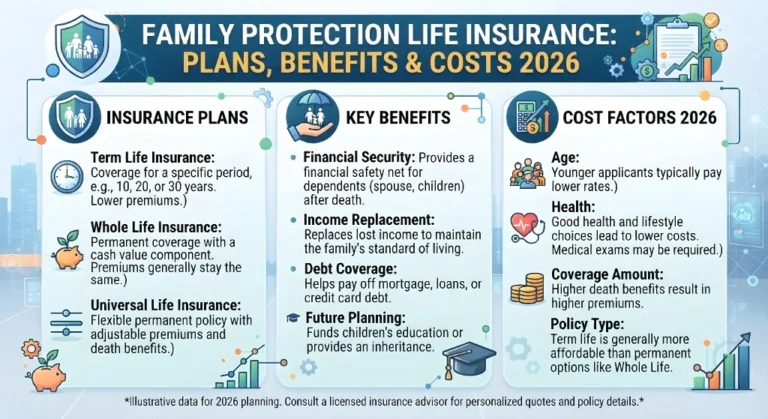
The honest answer is that most families need more than one of these. A term plan for large cover, a Savings and Investment plan for goal-based money, and a liquid emergency fund make a solid trio. If your first worry is replacing lost income, start by reading about Family Protection Life Insurance and then decide how much of your budget should go toward growth.
How to Choose the Right Savings and Investment Plan
Use this checklist before you sign anything. It takes twenty minutes and can save you years of frustration.
- Name the goal and the date. “Retire at 60” or “pay university fees in 2042” beats “save something.”
- Match the term to the goal. A plan that matures three years early leaves you with the wrong money at the wrong time.
- Ask about every charge. Allocation, admin, fund management, and cost of cover all reduce what reaches your fund.
- Separate guaranteed from projected. Bonuses and fund growth are estimates until they are declared.
- Read the surrender table. See what you would get back in years 3, 5, and 10.
- Check the insurer. Claims record, years in business, and regulator complaints tell you more than a brochure.
- Test the flexibility. Ask about premium holidays, top-ups, and partial withdrawals.
Charges, Tax, and the Fine Print
Charges are where Savings and Investment plans differ most. Ask for the allocation rate in year one, the yearly admin fee, the fund management fee, and the cost of cover. A plan that puts only 60 percent of your first-year premium to work is not automatically bad, but you should know that before you sign.
On tax, premiums paid toward life insurance may qualify for a credit under Pakistan’s income tax rules, and maturity proceeds can be treated differently depending on the plan and current law. Budgets change these rules often, so confirm with a tax adviser before you count on a saving.
Read the free-look period as well. Most insurers let you cancel within a short window after you receive the policy and get your premium back, less small costs. Use it. Reading the full document at home, once, is the cheapest protection you will ever buy.
Mistakes People Make with Savings and Investment Plans
- Buying only for the tax break. A tax credit is a bonus, not a reason to accept a plan that does not fit your goal.
- Setting a term that ends too soon. Money that arrives before you need it usually gets spent.
- Ignoring the cover amount. A plan with PKR 500,000 of cover will not protect a family that needs ten million. Guides on Family Protection Life Insurance explain how to size that number.
- Stopping after year two. The cost of lapsing is highest early, when charges have eaten the most.
- Skipping the nominee form. Outdated nominee details can delay a claim for months.
- Trusting a verbal promise. If an agent says returns are guaranteed, ask to see it in writing.
How to Buy a Plan: Step by Step
- Set a budget. Keep total Savings and Investment premiums at 10 to 15 percent of income, and only after an emergency fund is in place.
- Decide the goal and cover. Write down the target amount, the date, and how much cover your family would need.
- Request illustrations. Ask two or three insurers, for example State Life, for written benefit illustrations at low and mid growth assumptions.
- Compare line by line. Look at charges, surrender values, and guaranteed benefits, not just the headline maturity figure.
- Answer forms honestly. Health and income details must be accurate, or a future claim can be rejected.
- Use the free-look period. Read the policy, set up auto-debit, and put a yearly review in your calendar.
A Worked Example
Here is a made-up but realistic case. Ayesha is 32, married, with a two-year-old son. She earns PKR 120,000 a month and can spare 12,000. Her husband already holds a term plan, so she picks an 18-year child education plan in the Savings and Investment category. Over 18 years she will pay in about PKR 2.59 million.
If she dies, the premiums stop and the plan still pays for her son’s education. If all goes well, the fund matures when he turns twenty, right when university fees start. She did not chase the highest projected return. She picked the plan whose surrender values and charges she understood, and that made all the difference.
Savings and Investment Insurance FAQs
Hover over a question on a computer, or tap it on your phone, to see the answer.
What is a Savings and Investment insurance plan?
It is a long-term policy that pays for life cover and builds a fund at the same time. You pay a regular premium, and at maturity you receive the fund value. If you die during the term, your family receives the sum assured instead.
Are the returns guaranteed?
Only in part. Traditional endowment plans usually guarantee the sum assured and add bonuses that are not fixed. Unit-linked plans guarantee nothing on growth, because the fund value follows the market. Always ask which numbers are guaranteed and get them in writing.
How much should I put in each month?
A safe range is 10 to 15 percent of your monthly income, after you have set aside an emergency fund. Paying more than you can keep up for ten years is the fastest way to end up with a lapsed policy and a loss.
Can I take money out early?
Most plans allow partial withdrawals or loans after a few years, and surrender is possible at any time. The catch is that early surrender values are low because charges are front-loaded. Check the surrender table for years 3, 5, and 10 before you buy.
Is it better than a mutual fund?
Neither wins in every case. A mutual fund gives more flexibility and usually lower costs, but it has no life cover and depends on your discipline. A Savings and Investment plan gives protection and forced saving. Many families hold both.
What happens if I stop paying premiums?
In the first two or three years the policy often lapses and you may get little or nothing back. After that, most plans convert to a paid-up policy with reduced cover and reduced maturity value. Ask your insurer for the exact rule.
Do these plans cover critical illness or accidents?
Not by default. Riders for accidental death, disability, or critical illness can be added for a small extra monthly amount. Add them only if you do not already have that cover through work or another policy.
Is takaful a good alternative?
If you want a Shariah-compliant structure, family takaful plans offer protection plus a savings or investment account. The cost and returns are comparable to conventional plans, so compare the illustration and the fund manager, not just the label.
What is the best age to start?
The earlier the better. At 25 or 30 you pay less for the same cover and give compounding more years to work. Starting at 45 is still worthwhile, but expect higher premiums and a shorter growth window.
How long is the free-look period?
It varies by insurer, but most give somewhere between 14 and 30 days after you receive the policy documents. During that window you can cancel and get your premium back, less small costs such as medical fees.
Can I hold more than one plan?
Yes. Many people run a term plan for big income protection and a Savings and Investment plan for goals like education or retirement. Just make sure the total premiums fit comfortably inside your budget.
How do I check whether an insurer is reliable?
Look at its claims-paid ratio, years in business, financial rating, and complaint record with the regulator. Ask friends who have claimed. A slightly lower return from a trusted insurer beats a higher promise from an unknown one.
Back Where We Started
At the top we said money is usually lost by sitting in the wrong place. The fix is smaller than it sounds. Pick one goal, choose a term that ends when the goal begins, collect two written illustrations, and compare charges before headline returns. Then start before prices climb again.
If you already hold a policy and want a second opinion, or you are ready to request a quote, speak to an adviser at State Life and bring this guide along. The right Savings and Investment plan will feel boring in year one and very welcome in year fifteen.
Disclaimer: This article is general information and not personal financial, tax, or legal advice. Premiums, returns, and tax rules vary by insurer and change over time. All figures are illustrative estimates. Read your policy documents and speak with a licensed adviser before you buy.