
Endowment Assurance: Complete Guide to Benefits & Costs 2026
State Life Endowment assurance is a life insurance plan that combines financial protection with long-term savings. It can help protect your family financially while also building a lump sum that may be paid when the policy reaches its maturity date. In 2026, understanding how endowment assurance works, what it costs, and what benefits it offers is important before choosing a policy. This complete guide explains the key features, benefits, premiums, maturity value, advantages and disadvantages, and important factors to consider so you can make a confident and informed decision.
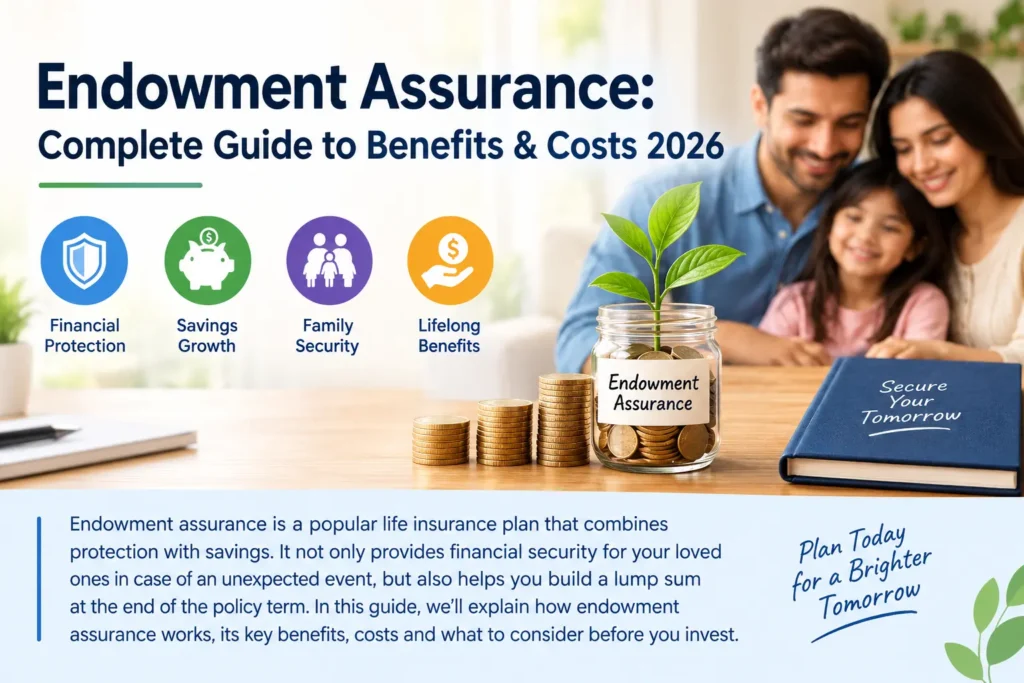
Endowment Assurance: Complete Guide to Benefits & Costs 2026
A plain-English look at what endowment assurance actually pays out, what it costs in 2026, and whether it deserves a place in your financial plan.
Picture two people the same age, earning roughly the same income. One puts money into a savings account every month and hopes nothing goes wrong before the goal is reached. The other signs up for an endowment assurance policy that promises a guaranteed lump sum either way — whether they’re alive to collect it or not. That difference, the certainty of a payout no matter what happens, is the entire reason this approach has stayed relevant for well over a century of insurance history.
This guide breaks it down the way a friend who works in insurance would explain it over coffee — not the marketing brochure version, but the real numbers, the real trade-offs, and the situations where it genuinely makes sense in 2026. You’ll find premium tables, a maturity growth chart, a straight comparison against Whole Life Assurance, and answers to the questions people actually type into Google before buying a policy.
What Is Endowment Assurance, Really?
At its core, this type of policy is a contract between you and an insurer. You agree to pay a premium — monthly, quarterly, or yearly — for a fixed number of years, say 15, 20, or 25. In return, the insurer promises one of two outcomes: if you pass away during that term, your beneficiaries receive the sum assured immediately. If you live to see the end of the term, you receive that same sum assured, often boosted with accumulated bonuses.
What sets endowment assurance apart from a simple term policy is that word “either.” Term insurance only pays if something happens to you. This plan pays regardless, which is exactly why the premiums run higher — you’re not just buying protection, you’re funding a forced savings plan that the insurer guarantees to return to you.
People often confuse it with pure investment products, but the two behave very differently. An endowment plan is priced conservatively because the insurer has to guarantee the payout no matter what markets do in between. That conservatism is the trade-off for certainty.

How Does an Endowment Assurance Policy Actually Work?
Every policy of this kind runs on three moving parts: the sum assured, the premium, and the term. The sum assured is the guaranteed minimum payout. The premium is what you pay to keep that guarantee alive. The term is the countdown clock — the number of years until maturity.
Behind the scenes, the insurer splits your premium into two buckets. A portion covers the pure life-cover cost, calculated using mortality tables. The rest gets invested conservatively — usually in government bonds and low-volatility instruments — to build the maturity fund. Many insurers also add annual or terminal bonuses on top of the guaranteed sum, depending on how their investment pool performs.
Here’s the part most people miss: because this structure blends insurance and savings, the returns are typically lower than what you’d get from investing the difference in equities over the same period. What you’re buying instead is predictability — a number you can plan a wedding, a mortgage deposit, or a retirement cushion around, years in advance.
The Three Payout Triggers
- Death during the term — beneficiaries get the sum assured plus any accrued bonus immediately.
- Survival to maturity — the policyholder receives the full guaranteed amount plus bonuses.
- Early surrender — the policyholder can exit early for a reduced, discounted surrender value after a minimum holding period.
Key Benefits of Endowment Assurance
The appeal comes down to five practical advantages that show up again and again in policyholder feedback.
| Benefit | What It Means for You |
|---|---|
| Guaranteed maturity payout | You know the minimum amount you’ll receive years before the policy ends, which makes long-term planning far easier. |
| Dual protection and savings | One premium does two jobs — life cover for your family and a disciplined savings pot for you. |
| Bonus accumulation | Many plans add yearly bonuses that compound the final payout beyond the base sum assured. |
| Tax efficiency | In most jurisdictions, maturity proceeds and death benefits from a qualifying policy are exempt from income tax. |
| Loan collateral | Once surrender value builds up, the policy itself can be pledged for a loan without cashing it in. |
None of this makes it the right fit for everyone, but for savers who struggle with discipline, the forced-payment structure is arguably the single biggest benefit. Skipping a premium has consequences, and that friction is exactly what keeps the savings goal on track.
Cost & Premium Breakdown for 2026
Premiums for endowment assurance depend on age at entry, policy term, sum assured, and health rating. The table below gives a realistic, illustrative snapshot of what a healthy non-smoking applicant might expect to pay for a mid-sized policy in 2026. Treat these as ballpark figures — your actual quote will vary by insurer and country.
| Age at Entry | Term | Sum Assured | Approx. Monthly Premium |
|---|---|---|---|
| 25 years | 20 years | $50,000 | $145 – $175 |
| 30 years | 20 years | $50,000 | $160 – $195 |
| 35 years | 15 years | $50,000 | $210 – $250 |
| 40 years | 15 years | $75,000 | $320 – $380 |
| 45 years | 10 years | $75,000 | $420 – $495 |
Two things push these numbers up or down more than anything else: entry age and term length. Buying young and locking into a longer term almost always produces a lower monthly outlay relative to the final payout, because the insurer has more years to spread the mortality risk and grow the invested portion of your premium.
Want a policy that’s actually built around your income and goals rather than a generic template? Compare tailored plans at staylifee.com and see real quotes side by side.
Endowment Assurance vs Whole Life Assurance
This is the comparison most people search for right before they buy, so it deserves a direct answer. An endowment assurance policy has a fixed finish line — the maturity date — after which the policy pays out and closes. Whole Life Assurance, on the other hand, has no fixed end date at all. It stays active for your entire life and only pays out on death, whenever that happens to be.
| Feature | Endowment Assurance | Whole Life Assurance |
|---|---|---|
| Payout trigger | Death or survival to maturity | Death only, at any age |
| Fixed term | Yes, typically 10–25 years | No fixed term — lifelong cover |
| Premium level | Higher, but time-limited | Lower per year, paid longer or for life |
| Best for | Medium-term goals with a target date | Estate planning and lifelong protection |
If your priority is a guaranteed lump sum tied to a specific date — a child’s education, a mortgage payoff, or retirement — this option is the more natural fit. If the priority is leaving behind a payout no matter when you pass away, decades from now included, Whole Life Assurance is the better structural match. Some households end up holding both, using one for near-term goals and the other for long-term family security.
How Endowment Assurance Grows Over Time
The chart below illustrates a typical growth pattern for a 20-year endowment assurance policy with a $50,000 sum assured and modest reversionary bonuses added each year. Notice how the payout accelerates in the later years as bonuses compound on top of the base guarantee.
Illustrative maturity growth of a $50,000 policy with annual bonuses. Actual figures vary by insurer and bonus rate.

Who Should Actually Buy Endowment Assurance?
It tends to fit a specific kind of saver, not everyone. It works well if:
- You want a guaranteed number tied to a fixed date — a child turning 18, a wedding, a mortgage clearing.
- You’ve struggled to stick with self-directed investing and want a structure that enforces discipline.
- You’re risk-averse and prefer a guaranteed floor over the higher, but uncertain, returns of market investing.
- You want life cover and savings combined into one manageable premium instead of juggling two separate products.
It’s a weaker fit if you’re comfortable managing a separate term policy alongside your own investment portfolio, since that combination usually produces a higher expected return over the same horizon — just without the guarantee.
Pros and Cons at a Glance
| Pros | Cons |
|---|---|
| Guaranteed lump sum at maturity | Lower returns than pure investment vehicles |
| Life cover built in from day one | Higher premiums than term-only insurance |
| Encourages consistent saving habits | Surrendering early usually means a loss |
| Often tax-advantaged at maturity | Less flexibility once the term is locked in |

How to Choose the Right Endowment Assurance Plan
Not every policy of this kind is built the same way, so it’s worth checking a few things before signing anything.
1. Match the term to your actual goal
If the money is meant for a child’s university fees in 18 years, don’t buy a 25-year policy just because the premium looks lower. Align the maturity date with the date you actually need the funds.
2. Compare bonus history, not just headline rates
Ask insurers for their bonus track record over the last 10–15 years rather than relying on a single projected figure. A consistent bonus history says more about reliability than a flashy illustration.
3. Understand the surrender terms upfront
Life circumstances change. Know exactly what you’d get back — and after how many years — if you needed to exit the policy early.
4. Check whether riders make sense
Critical illness or accidental death riders can be added to most policies for a modest extra premium, and they’re worth considering if you don’t already have separate cover.
Ready to see what an endowment assurance plan would actually cost for your age and goals? Get a personalised breakdown at staylifee.com — no obligation, just real numbers.
Real-World Scenario: Planning a Fixed Goal
Take a 32-year-old parent who wants $60,000 available the year their child turns 18, currently six years old. A 12-year term matches that timeline exactly. Rather than guessing at a lump sum today and hoping investment markets cooperate, the parent locks in a guaranteed minimum and lets bonuses stack on top over the years. If something happens to the parent in year four, the family still receives the full guaranteed amount immediately — the plan doesn’t ask the child to wait until the original maturity date.
This is the scenario where the trade-off makes the most sense: a real deadline, a real dependent, and a preference for a guaranteed floor over a hopeful projection. Contrast that with someone saving for a flexible, undated goal like “financial freedom someday” — in that case, a mix of term cover and separate investing usually serves better, since there’s no fixed date the payout needs to arrive by.
Inflation and Long-Term Planning
A guaranteed sum sounds reassuring until you factor in what prices will look like by the time the policy matures. A payout that feels generous today can feel modest fifteen or twenty years down the line once everyday costs have crept upward. The practical fix is straightforward: size the sum assured a little higher than your current target number, and revisit the figure every few years as your income grows, rather than locking in a number based purely on today’s cost of living.
Common Mistakes People Make With Endowment Assurance
- Buying based on the agent’s projection alone — projected bonuses aren’t guaranteed; only the base sum assured is.
- Choosing too short a term to save on premium — this often defeats the compounding advantage bonuses offer in later years.
- Ignoring inflation — a $50,000 payout in 20 years won’t have the same purchasing power it has today, so it helps to size the sum assured accordingly.
- Ignoring the difference between endowment assurance and Whole Life Assurance — the two solve different problems, and picking the wrong one wastes years of premium.
Frequently Asked Questions
What exactly is endowment assurance?
Is endowment assurance a good investment in 2026?
How is endowment assurance different from term insurance?
How does endowment assurance compare to Whole Life Assurance?
What happens if I stop paying premiums early?
Can I borrow against my policy?
Are endowment assurance payouts taxable?
What’s the ideal age to start an endowment assurance policy?
Can I hold both endowment assurance and Whole Life Assurance together?
Final Thoughts
Endowment assurance isn’t the flashiest product on the shelf, and it was never designed to be. It’s built to do one thing reliably: hand you or your family a guaranteed sum of money on a date you can plan around, whether life goes exactly to script or not. For savers who value certainty over the chance of higher but unpredictable returns, that guarantee is worth the higher premium.
Before committing, run your numbers against a couple of different terms and sum assured levels, check the insurer’s bonus history, and be honest about whether a fixed maturity date or lifelong cover actually matches your goal. If you’re still weighing endowment assurance against other structures, a side-by-side quote comparison at staylifee.com is a fast way to see real premiums instead of rough estimates.


One Comment